Electrons, qubits and photons: three ways a chip can work
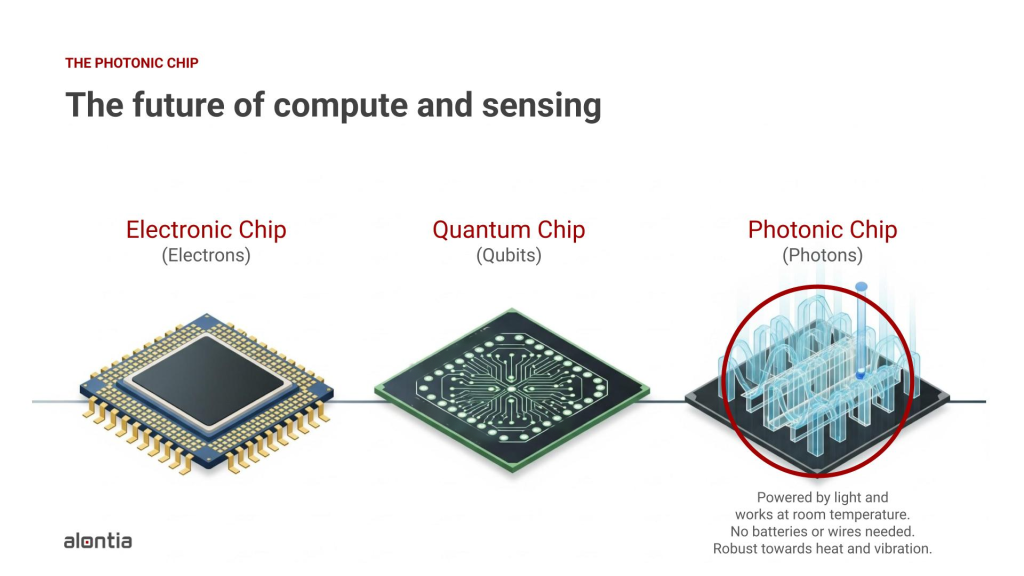
When most people hear the word chip, they picture the processor in their phone or laptop. But there are already three main classes of chip technology, and each one collects and moves information in a fundamentally different way: with electrons, with qubits, or with light.
Each has its own strengths and its own physical limits. Understanding those limits is the key to seeing why photonic chips matter, and why they are especially well suited to sensing in the real world.
1. Electronic chips: the workhorse
Electronic chips move information as electrical current, carried by electrons through billions of transistors. They power almost everything digital, from your phone to the largest AI data centers.
Their strength is decades of refinement and an enormous manufacturing base. Their limits are physical: every electron moving through a wire produces heat, every chip needs a power supply and wiring, and high-performance chips need serious cooling. The newest AI accelerators are now liquid-cooled as standard, because air is no longer enough.
2. Quantum chips: extraordinary, but fragile
Quantum chips work with qubits, which can hold combinations of states at once. For certain problems, such as simulating molecules or some optimisation tasks, this could eventually outperform any classical computer.
The catch is fragility. Most quantum chips must be cooled to temperatures close to absolute zero and shielded from vibration and electromagnetic noise. They live in specialised labs and cloud facilities, not in the field, and for now they remain largely a research and early-access technology.
2. Photonic chips: running on light
Photonic chips use light instead of electrons. This is where we work at Alontia.
Our chips are built from nanostructures that interact directly with light. When light hits the chip, the nanostructure responds to specific wavelengths, and that response changes in a measurable way depending on what the chip is in contact with. The chip itself does the sensing, using nothing but light.
That has practical consequences:
- They work at room temperature, with no cooling required.
- They need no batteries or wires on the chip itself.
- They hold up to heat and vibration.
In other words, photonic chips are strong exactly where electronic and quantum chips are weakest: in demanding physical environments, outside the controlled conditions of a lab or data hall.
Not a competition, but a combination
The future is not about choosing one architecture over the others. Electronics will keep dominating general-purpose computing. Quantum processors may one day accelerate specific calculations. Photonics is already opening new possibilities in sensing and communication.
This integration is already happening. In Google’s AI data centers, the processors that train and run models are electronic, but optical circuit switches route data between thousands of them, because light moves large volumes of data faster and more efficiently than copper.
Our own products follow the same logic. The photonic chip does the sensing, electronics read the optical signal, and software turns it into an answer. Each technology does the job its physics is best at.
Bringing measurement to the process
The biggest advantage of photonic sensing is that it can move measurement out of the central lab and closer to the physical process. Today, many critical fluid analyses still mean drawing a sample, shipping it to a laboratory and waiting days for the result. By then, the engine has kept running, the batch has been processed, or the problem has grown.
Robust, room-temperature photonic sensors can work where that delay costs the most:
- Ship engine rooms, where fuel, lubricant and coolant quality affect safety, emissions and maintenance.
- Refineries and process plants, where faster results mean tighter control.
- Field labs and remote sites, where a full laboratory is not available.
- Cooling systems, including the liquid-cooled data centers now being built for AI, where coolant condition directly affects uptime.
In each case, the value is the same: a reliable answer on-site, while there is still time to act on it.
From the lab to production
Photonics has been promising for a long time. What has often held it back is not the physics, but manufacturing: making chips reproducibly, at scale and at a cost that makes commercial sense.
That is why Alontia is among the front runners to produce chip at our new facility just north of Copenhagen. Applications include fluid analysis in maritime and industrial settings, where on-site results save real time and money.
The future of compute and sensing will not be the electronic chip alone. Looking at the challenges the world will face in the coming decades, from energy and emissions to the infrastructure behind AI, the photonic chip holds great potential. We intend to help realise it.