AI can see. It cannot yet smell or taste.
AI can see. Computer vision reads images better than most people. AI can hear, too: speech models understand almost any voice in almost any language. But AI cannot smell or taste, at least not outside a laboratory.
That may sound like a curiosity, but it matters. Most of what goes wrong in the physical world doesn’t show up in a picture or a sound. It’s in the chemistry: a fuel that has degraded, an oil carrying early signs of wear, a coolant that is slowly losing its protection. Until AI can sense chemistry where things happen, it stays partly blind to the world it is supposed to help run.
Think of AI like a human body
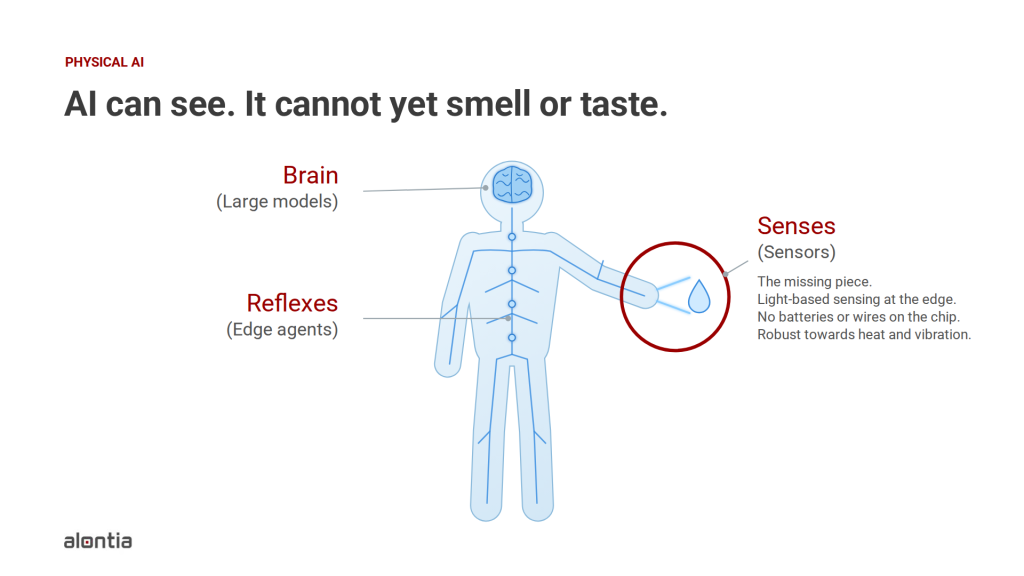
A useful way to understand where AI stands today is to compare it with the human body:
- The brain. It thinks, learns and plans. For AI, that’s the large models running in data centers, and they become more capable every month.
- The reflexes. When you touch something hot, your hand pulls back before your brain is even involved. For AI, that’s the small agents at the edge that can act locally, on their own, without waiting for the cloud.
- The senses. Sight, hearing, touch, smell and taste tell both the brain and the reflexes what is actually happening in the world. For AI, those are the physical inputs: the sensors.
The brain is here. The reflexes are arriving. The senses are where the gaps are.
The missing chemical senses
Look at what AI actually learns from. It reads through text: books, websites and code. It sees through images and video, captured by billions of cameras. It hears through sound. These inputs are everywhere, and that’s why AI has become so good at language, vision and speech.
The chemical senses, smell and taste, are almost missing. There is research on machine olfaction and there are electronic noses, but chemical sensing remains niche compared with vision and audio, and it rarely works robustly outside controlled conditions.
For a machine, the closest thing to smell and taste is a spectrum: a measurement of how a sample absorbs and reflects light across many wavelengths. A spectrum is a chemical fingerprint. It reveals what a sample is made of, not just how it looks.
Spectral data is locked in the lab
Spectra are not new. The chemometrics community has worked with spectral data for decades, mostly using linear models such as PCA and PLS, combined with careful calibration. These methods work well, and they are still the standard in many industries.
The limitation is not the methods but the data. Every calibration sample needs a reference value from a laboratory analysis, so datasets are small and expensive, typically tens to a few thousand samples. Compare that with the billions of images behind modern computer vision. There is no ImageNet for spectra.
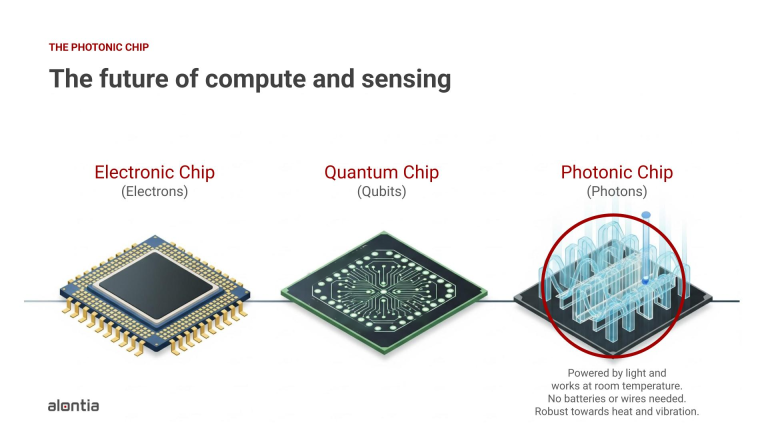
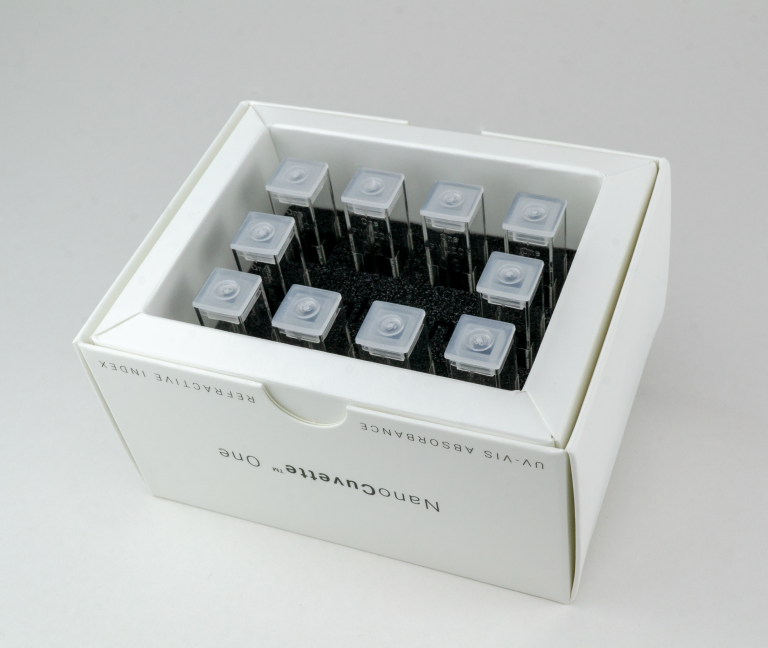
That is starting to change. Photonic chips, like those we develop at Alontia, together with affordable high-quality spectrometers, make it possible to collect spectra on site and at scale, not just in the lab. Because each spectrum captures many wavelengths at once, the measurement carries built-in redundancy and stays robust under real-world conditions such as ambient light, vibration and imperfect sample handling.
The blood of the machine
Oil, fuel and coolant are the blood of a machine. They flow through the whole system and pick up information along the way: wear particles, contamination, degradation. Just as a blood test tells a doctor about the health of a patient, a fluid sample tells an engineer about the health of an engine. That’s why oil analysis is often called a blood test for machines.
Today, that blood test usually means sending a sample ashore and waiting days for a lab report. Medicine moved many blood tests from the central lab to the bedside decades ago. Machines are next.
This is not about replacing people. An experienced chief engineer can smell a fuel and know something is off, and hear when an engine doesn’t sound right. That experience is hard-won and valuable. But no engineer can sense the chemistry inside a sample. Give AI that sense, and it can work next to the engineer, interpreting a measurement on site in minutes, even offline in the middle of the ocean.
A fleet that learns like a brain
Then comes the part humans cannot do on their own. In a commercial fleet today, when one engineer runs into a problem, such as a bad bunker batch or a new kind of contamination, the lesson travels slowly. It moves through incident reports, superintendents, crew rotations and the next training course. It can take months to reach the rest of the fleet, and some ships never hear about it.
A swarm of connected sensors and agents across a fleet works differently. Each unit is designed to be autonomous: when there’s no internet, it works fully on its own. When a connection is available, its agent joins the swarm. When one of them learns something new, every other unit knows as soon as it reconnects.
Every measurement also adds to the shared data. Some of it is anchored in reference analyses from the lab, which teach the system what a spectrum means. The rest helps it spot changes and anomalies early. Either way, the swarm keeps getting better, just like our brain does with experience.
This is how the chemical senses for AI will get built: not in one lab, but across thousands of ships, ports and plants.
Giving AI its senses
AI has made remarkable progress by learning from what we write, photograph and record. The next step is to let it sense what things are made of, in the places where decisions are made: on ships, in ports, in plants and in the field.
The brain is here. The reflexes are coming. Now AI needs its senses. At Alontia, we are building them with light.