
Overview
The SpectroCuvette™ One is an excellent improvement in any laboratory workflow for quantitative analysis in numerous industries such as biotechnology, pharmaceuticals, chemistry, foods and industrial applications for quality control.
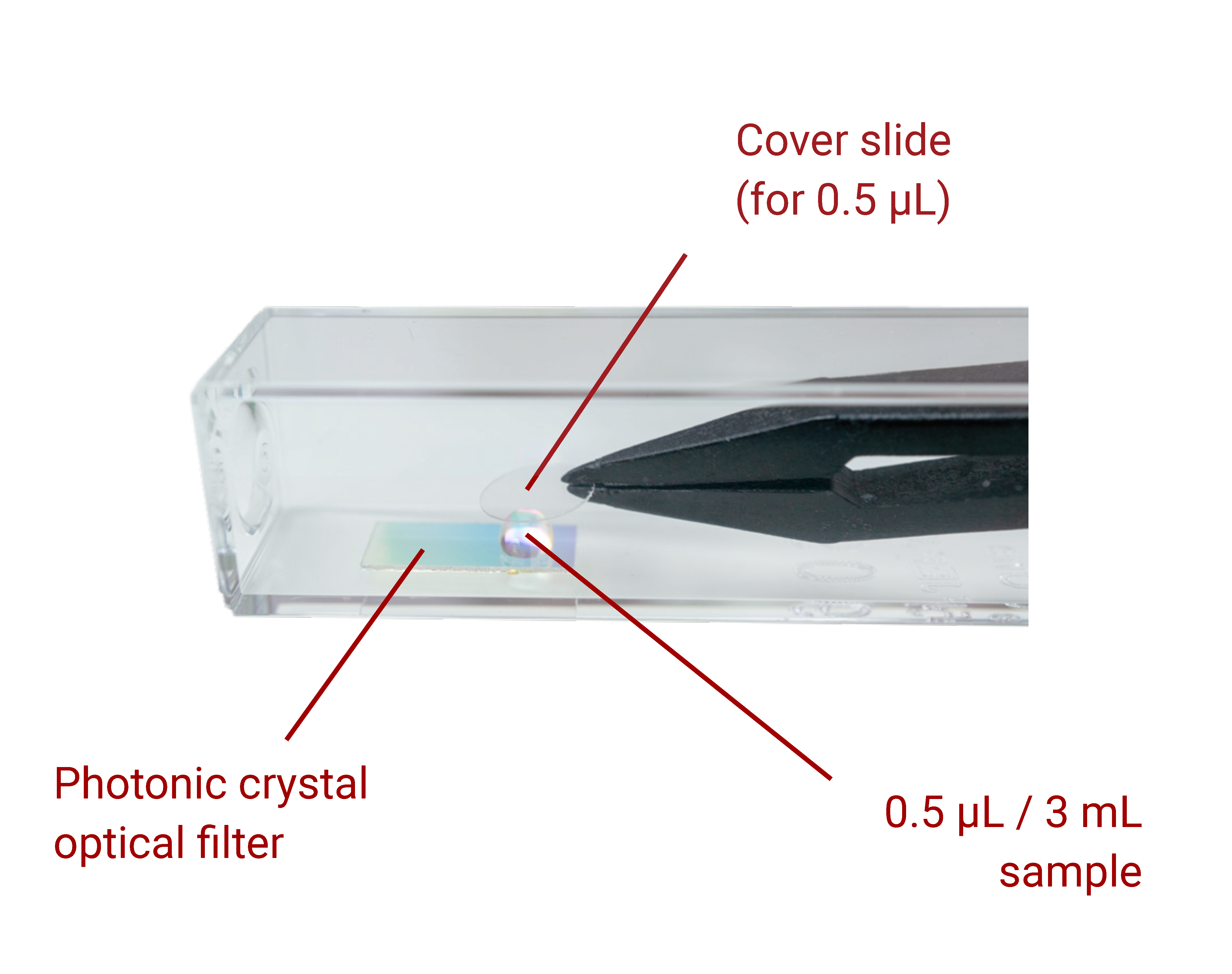
The capacity of SpectroCuvette™ One goes far beyond any product currently on the market in terms of concentration determination. With the SpectroCuvette™ One you are able to analyze smaller samples (down to 0.5 μL) and a large range of concentrations (0.02 – 300 mg/mL) of non-absorbing compounds.
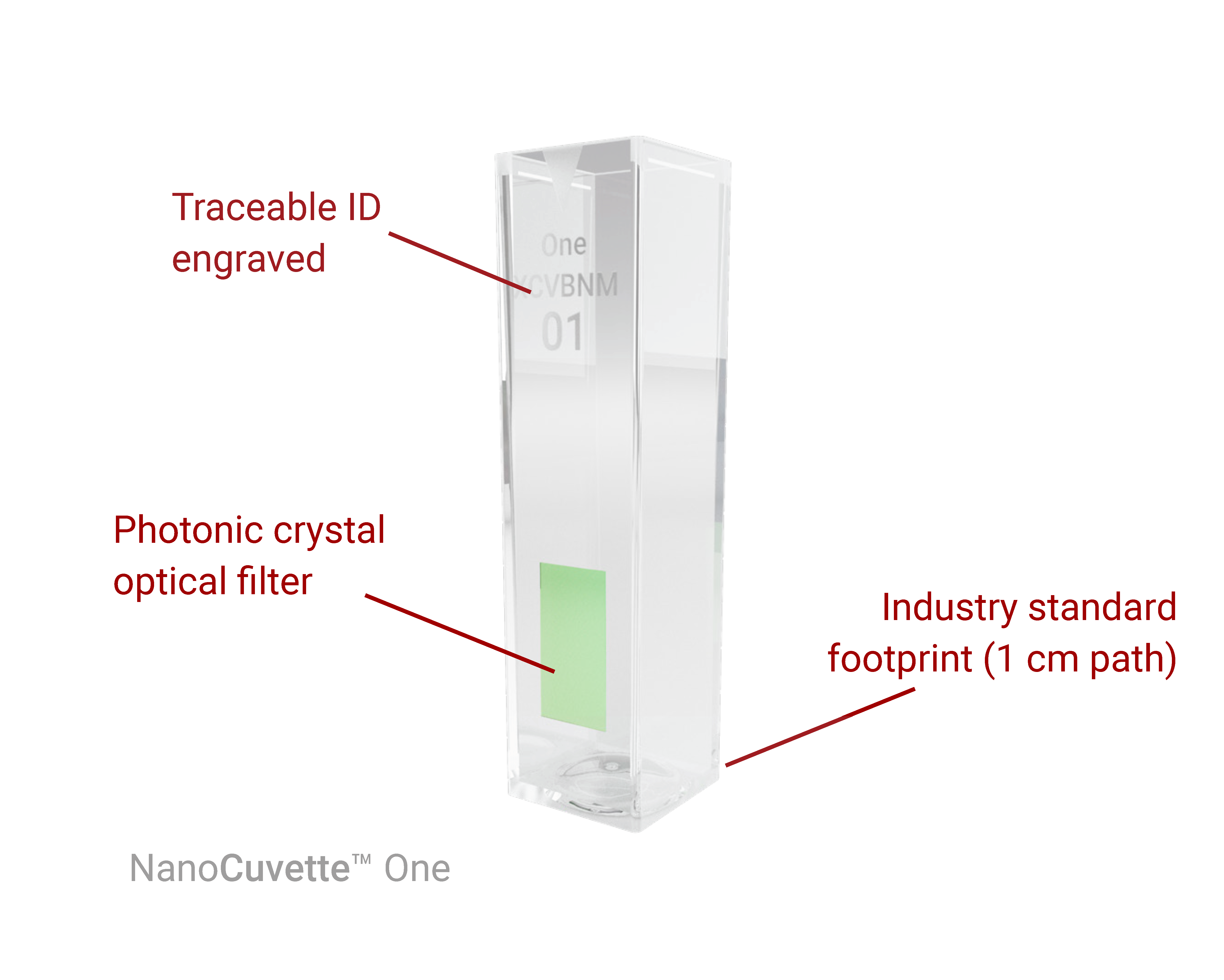
Together with the unique free online software SpectroWorks™ it is possible to calculate a number of different results of a sample, such as concentrations and user-defined parameters. Thereby, you can determine concentrations without any dye or fluorescence for compounds such as carbohydrates, proteins or perform chemical or enzymatic kinetic studies.
SpectroCuvette™ One key uses:
Less sample needed for analysis
Enzymes and proteins can be expensive, some equipment needs 2 to 3 μL to measure protein. The SpectroCuvette™ One can measure volumes down to 0.5 μL and concentrations down to 0.2 mg/mL for sucrose (Limit of detection is below 0.2 mg/mL sucrose concentration).
Label-free concentration determination
SpectroCuvette™ One’s optical filter measures refractive index and together with SpectroWorks™ it will calculate the refractive index similar to SPR. Refractive index does not require any coloration (dye or indicator) to be measured. Thus it is possible to measure concentrations with a spectrophotometer of a transparent solution.
Monitoring label-free enzymatic reactions
Direct label-free detection of enzymatic activity with a substrate can be monitored with the change in the intrinsic property refractive index of the solution as product is formed over time. The SpectroCuvette™ One has a built-in optical filter allowing it to measure refractive index changes due to enzymatic reaction kinetics in real time using an UV-Vis spectrophotometer.
 Label-free protein concentration determination
Some proteins can be quantified by absorption spectroscopy as aromatic amino acids absorb UV light at 280 nm. Depending on the amount of protein, it will absorb more or less light at 280 nm and have a higher or lower extinction coefficient. The extinction coefficient can be calculated theoretically, but these values are often 10 % or more incorrect. With label-free spectroscopy the extinction coefficient has been determined with high precision. The protein refractive index is a quick way of obtaining the protein concentration without the need of making a standard curve. As an additional advantage, this method also allows for direct quantification of your protein without prior dilution.
Label-free protein concentration determination
Some proteins can be quantified by absorption spectroscopy as aromatic amino acids absorb UV light at 280 nm. Depending on the amount of protein, it will absorb more or less light at 280 nm and have a higher or lower extinction coefficient. The extinction coefficient can be calculated theoretically, but these values are often 10 % or more incorrect. With label-free spectroscopy the extinction coefficient has been determined with high precision. The protein refractive index is a quick way of obtaining the protein concentration without the need of making a standard curve. As an additional advantage, this method also allows for direct quantification of your protein without prior dilution.
Why do we upgrade UV-Vis spectrophotometry?
Traditionally, spectrophotometry laboratory work has been limited by lack of robust methods to determine concentrations. We upgrade UV-Vis spectrophotometry around the world and across all major instrument brands to create new ways to determine concentration, perfom enzymatic studies in a label-free, fast, cheap, and reliable method.